Your smile is your welcome sign to the world. It’s a universal language of joy, confidence, and connection. It’s one of the first things people notice when they meet you. So, when a front tooth is missing due to injury, decay, or congenital reasons, it’s more than a dental issue—it’s a personal one. It can affect how you speak, what you eat, and, most importantly, how you feel about yourself in social and professional situations. You might find yourself hiding your smile in photos, covering your mouth when you laugh, or feeling self-conscious in every conversation.
At Prosmiles Dental, we understand this deeply. We know that considering a front tooth implant can feel overwhelming. A whirlwind of questions about the cost, the complex-sounding procedure, and whether the result will truly look and feel natural can create anxiety.
This complete guide is designed to be your trusted, one-stop resource. We’ll walk you through every aspect of front tooth implants, demystifying the process, breaking down the investment, and painting a clear picture of what you can truly expect. Consider this your first, confident step toward reclaiming not just your smile, but your peace of mind and self-assurance.
What is a Front Tooth Implant? The Three-Part Miracle
Let’s start with the basics. A dental implant is a permanent, fixed solution for a missing tooth, widely regarded as the most advanced and natural-looking option available. It’s not just a replacement; it’s a prosthetic system that mimics your entire natural tooth structure.
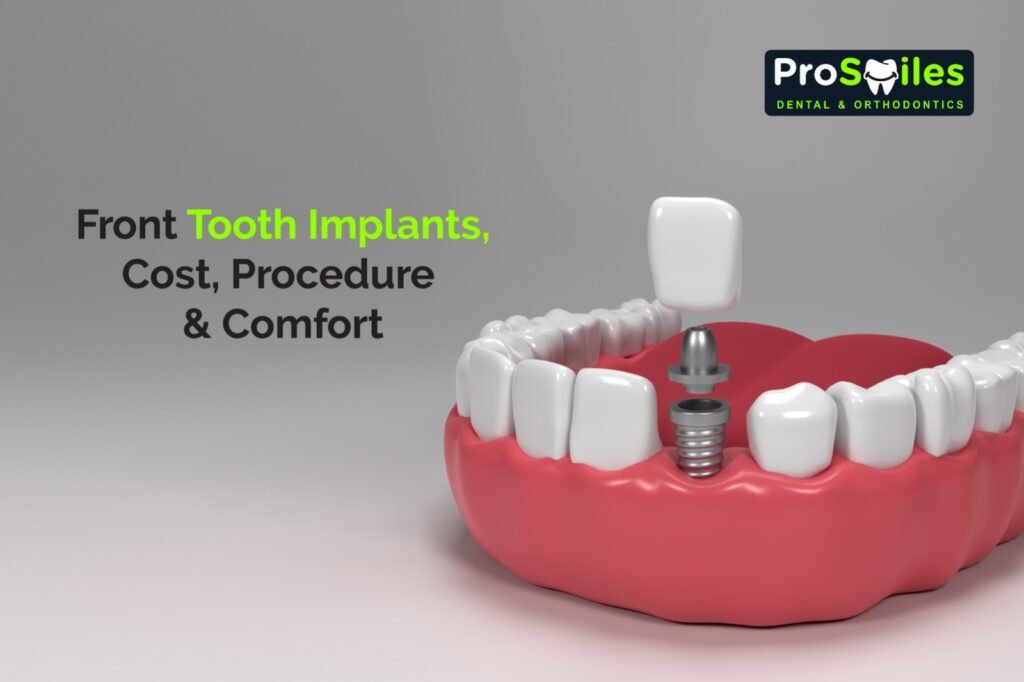
Think of it as a three-part system:
- The Implant Post: This is a small, incredibly strong, biocompatible titanium screw that acts as an artificial tooth root. It’s surgically placed into your jawbone during a minor procedure. Titanium is used because it has a unique property called osseointegration—it naturally fuses with your living jawbone, creating an anchor that is just as strong, if not stronger, than a natural tooth root.
- The Abutment: Once the implant post has fused with the jawbone, a connector piece called an abutment is attached to it. This abutment protrudes slightly above the gum line and serves as the secure base for your final crown. It’s the critical link between the foundation and the visible tooth.
- The Crown: This is the visible, white part of the tooth that everyone sees when you smile. For a front tooth implant, the crown is the star of the show. It’s a custom-made masterpiece, meticulously crafted in a dental lab by skilled technicians. They use high-quality porcelain or zirconia to match the exact color, shape, size, and translucency of your surrounding natural teeth. The goal is a seamless blend—so perfect that no one can tell which tooth was ever missing.
Why a Front Tooth Implant is the Unrivaled Gold Standard
While other options like dental bridges or removable partial dentures exist, implants are consistently considered the superior choice, especially for a highly visible front tooth. Here’s why:
The Unmatched Aesthetic Advantage
For a front tooth, appearance is paramount. A dental bridge requires grinding down the two healthy teeth adjacent to the gap to support the false tooth. An implant, however, stands independently. This means we leave your perfectly healthy neighboring teeth untouched. The crown is designed to emerge from the gum line just like a natural tooth, creating a lifelike profile that bridges often struggle to achieve. The result is a smile that is not just restored, but authentically rejuvenated.
The Profound Functional and Health Benefits
- Bone Preservation: When you lose a tooth, the jawbone in that area no longer receives stimulation from the tooth root. This causes the body to resorb the bone, leading to bone loss over time. This can actually change the shape of your face, causing a prematurely aged, sunken appearance. An implant post replaces the root, providing that essential stimulation and preventing bone loss, thereby preserving your facial structure.
- Protection of Adjacent Teeth: As mentioned, a bridge requires altering healthy teeth. This enamel is gone forever and can make those teeth more susceptible to decay and sensitivity in the future. An implant protects the long-term health of your entire smile.
- Stability and Function: An implant is fixed in place. You can bite, chew, and speak with complete confidence, without worrying about any slipping or movement. It feels and functions exactly like a natural tooth.
Implant vs. Bridge: A Critical Comparison for Your Front Tooth
| Feature | Dental Implant | Traditional Dental Bridge |
| Impact on Adjacent Teeth | None. Healthy teeth are left untouched. | Requires grinding down and capping the two adjacent teeth. |
| Bone Health | Preserves and stimulates jawbone, preventing bone loss. | Does not prevent bone loss in the empty socket. |
| Longevity | The implant post can last a lifetime with proper care. | Typically lasts 10-15 years before needing replacement. |
| Aesthetics | Excellent. Emerges naturally from the gum line. | Very Good, but can sometimes have a less natural gum line. |
| Function | Feels and functions like a natural tooth. | Can feel different and may require altered flossing techniques. |
| Cost | Higher initial investment. | Lower initial cost, but may cost more over a lifetime due to replacements. |
Are You a Candidate for a Front Tooth Implant?
Most adults in good general and oral health are excellent candidates for a front tooth implant. During your consultation, we will evaluate several key factors:
- Sufficient Jawbone Density: You need adequate bone volume and density to securely hold the implant. If you’ve been missing the tooth for a while, some bone loss may have occurred. The good news is that this can often be addressed with a minor procedure called a bone graft.
- Healthy Gums: Your gums must be free from active periodontal (gum) disease, which can compromise the healing and long-term health of the implant.
- Good Overall Health: Well-controlled chronic conditions (like diabetes) are generally fine, but certain uncontrolled diseases or medications (like bisphosphonates) can affect healing.
- Being a Non-Smoker: Smoking significantly impairs healing and can drastically reduce the success rate of dental implants. We strongly advise patients to quit before undergoing the procedure.
The only way to know for sure is through a professional consultation with advanced 3D imaging. To learn more about the specific requirements for front tooth replacement, read our dedicated article: Can You Have a Dental Implant on a Front Tooth?
The Front Tooth Implant Procedure: A Step-by-Step Journey
Understanding the process is the best way to ease anxiety. Here’s a detailed look at what you can expect from start to finish.
Step 1: The Initial Consultation & 3D Imaging.
This is the most critical planning stage. We’ll discuss your medical history, your goals, and conduct a thorough oral examination. The cornerstone of this visit is a 3D Cone Beam CT scan. This technology provides us with a detailed, three-dimensional view of your jawbone, allowing us to assess bone density, locate nerves and sinuses with precision, and virtually plan the ideal size, angle, and position for your implant. This digital planning ensures the highest level of safety, predictability, and aesthetic success.
Step 2: The Implant Placement Surgery
On the day of your surgery, you will be made completely comfortable with local anesthesia. For patients who experience dental anxiety, sedation options are also available. Our skilled surgeon will make a small, precise incision in your gum tissue to expose the bone. Using the surgical guide from our 3D plan, they will gently create a small space in the bone and place the titanium implant post. The gum is then closed with sutures. The entire process for a single implant is typically very quick, often taking less than an hour.
Step 3: The Healing & Osseointegration Phase
This is the most important biological phase, typically lasting 3 to 6 months. During this time, you’re healing, but something incredible is happening beneath the surface: osseointegration. The bone cells in your jaw grow and fuse directly with the specially treated surface of the titanium implant, locking it into place. This creates a foundation that is as strong as a natural tooth root. During this phase, you’ll wear a temporary tooth replacement option, which we will carefully design to be aesthetically pleasing.
Step 4: Placing the Abutment & Your Temporary Crown
Once osseointegration is confirmed, a minor second procedure is performed. We reopen the gum tissue (a very small opening) to expose the top of the healed implant. The abutment is then screwed securely into the implant post. In many front tooth cases, we will attach a carefully crafted temporary crown to the abutment at this stage. This allows the gum tissue to heal and form a natural, aesthetic collar around the future permanent crown.
Step 5: The Final Reveal: Your Custom, Permanent Crown is Attached
After your gums have healed beautifully around the abutment (usually in a few weeks), we take highly detailed digital impressions of the area. These impressions are sent to a master dental lab where your permanent crown is crafted. We pay meticulous attention to shade matching, ensuring the porcelain mimics the subtle variations and translucency of your natural teeth. At your final appointment, we securely attach your new, permanent crown to the abutment. You will leave our office with a complete, confident, and radiant smile.
For a detailed walkthrough of the entire process, read our guide: The Dental Implant Process: From Start to Finish
The Game-Changer: Exploring Same-Day Front Tooth Implants
We live in an era of incredible dental innovation. For select patients who are good candidates, it is now possible to place a temporary crown on the implant on the very same day as the surgery. This “teeth in a day” or “immediate load” protocol can be a life-changing option, as it means you never have to spend a single day without a tooth.
It’s important to note that this approach requires specific conditions, such as excellent bone quality and primary stability of the implant. Discover if you might be a candidate for this efficient and transformative approach: The Same-Day Dental Implant Process and What You Can Expect
How Much Does a Front Tooth Implant Cost?
Let’s address the question on everyone’s mind with transparency and clarity.
What’s Included in Your Total Cost?
When you receive a quote for a dental implant, it should be an “all-in-one” fee that typically encompasses:
- The surgical procedure for implant placement.
- The cost of the implant post itself.
- The abutment.
- The custom-designed permanent crown.
- All necessary diagnostic images, including the 3D CT scan.
- Follow-up visits and check-ups.
Key Factors Influencing Your Personal Investment
The cost for a single front tooth implant in the US can range from $3,000 to $6,000. This variation depends on:
- Geographic Location: Fees can differ between cities and regions.
- The Dentist’s Expertise: The experience and training of your implant surgeon and restorative dentist are reflected in the cost.
- The Need for Additional Procedures: If you require a bone graft or gum contouring to achieve the ideal aesthetic result, this will add to the cost.
- The Material of the Crown: High-quality, aesthetically focused materials like zirconia for the crown may cost more but offer superior beauty and strength for a front tooth.
Making It Affordable: Cost-Friendly Options and Financing
We believe that financial concerns should never be the sole barrier to achieving a healthy, confident smile.
- Dental Insurance: While insurance plans often do not cover the full cost of implants, many may cover part of the procedure, such as the crown, similar to a traditional bridge. Our team is expert at helping you understand your benefits.
- Payment Plans & Financing: We work with third-party healthcare financiers like CareCredit® and Proceed Finance, which offer low- or no-interest payment plans. This allows you to break down the total cost into manageable monthly payments.
- Dental Savings Plans: We may offer in-house savings plans for preventive and restorative care.
Explore your options in our detailed cost articles:
- How Much Do Dental Implants Cost in 2025?
- What Are the Cost-Friendly Options Available for Dental Implants?
What Should You Know About the Recovery and Comfort After an Implant?
During the Procedure: Will It Hurt?
This is one of the most common fears, and the answer is a resounding no. With modern local anesthetics (and sedation if you choose), the implant placement itself is a painless procedure. You will feel pressure and vibration, but no sharp pain. Our team’s top priority is your comfort.
After the Surgery: The First Few Days
It is completely normal to experience some minor side effects after the anesthesia wears off. This includes:
- Swelling of your gum and cheek.
- Minor bruising on your skin.
- Discomfort at the implant site.
- Minor bleeding.
These effects are typically mild and peak within 2-3 days. They can be easily managed with over-the-counter pain medication (like ibuprofen), an ice pack applied to the cheek, and a soft-food diet. We provide you with clear, written post-operative instructions to ensure a smooth recovery.
Long-Term Comfort: Living with Your Implant
Once the initial healing is complete and your permanent crown is placed, the implant should feel completely natural. In fact, after a short while, you will forget it’s even there! It becomes a seamless part of your body, allowing you to eat, speak, and smile without a second thought.
Caring for Your New Smile: A Guide to Maintenance and Longevity
A dental implant is a lifelong investment, and with proper care, it can last for decades, often a lifetime. The brilliant part? Caring for an implant is no different than caring for a natural tooth—in fact, it might be easier since the implant post itself cannot decay.
- Brushing: Brush twice a day with a soft-bristled toothbrush.
- Flossing: Floss daily, using implant-specific floss or threaders if needed to clean around the abutment.
- Regular Check-ups: Visit Prosmiles Dental every six months for a professional cleaning and examination. We will check the health of your gums, the stability of the implant, and the condition of the crown.
For a complete guide on ensuring the longevity of your investment, read our blog: How to Maintain Your Dental Implants
Your Journey to a Confident Smile Starts Here
Choosing a front tooth implant is an investment in your health, your function, and your confidence. It’s a decision that pays dividends every single day—in the freedom to laugh unabashedly, the confidence to speak in a meeting, and the joy of enjoying your favorite foods without a second thought.
At Prosmiles Dental, we combine cutting-edge technology, like 3D imaging and guided surgery, with an artist’s eye for aesthetic detail. We are not just placing implants; we are restoring smiles and rebuilding confidence. Our team is here to guide you through every step of this transformative journey with compassion, expertise, and transparency.
Ready to take the next step? Your new, confident smile is within reach. Contact Prosmiles Dental today to schedule your personalized, no-obligation consultation. Let’s discuss your goals, answer your questions, and create a treatment plan tailored just for you.
Frequently Asked Questions About Front Tooth Implants
Q: How long does the entire process take from start to finish?
A: The timeline can vary, but you should generally expect the process to take between 3 to 6 months. The majority of this time is dedicated to the healing and osseointegration phase, which is critical for long-term success.
Q: Will people be able to tell that I have a fake tooth?
A: Absolutely not. When performed by an experienced team and crafted by a skilled lab technician, a front tooth implant is virtually indistinguishable from your natural teeth. We take immense pride in achieving results that are not just functional, but undetectably beautiful.
Q: Is the procedure painful?
A: The procedure itself is not painful due to effective anesthesia. Any post-operative discomfort is typically mild, similar to a tooth extraction, and is easily managed with over-the-counter medication.
Q: How long do front tooth implants last?
A: With excellent oral hygiene and regular dental check-ups, the implant post itself is designed to last a lifetime. The crown may eventually need replacement due to normal wear and tear after 15-20 years, but it is a simple process of unscrewing the old one and attaching a new one.
Q: What if I don’t have enough bone for an implant?
A: This is a common situation, especially if the tooth has been missing for a long time. In most cases, we can perform a minor bone grafting procedure to build up the jawbone, creating a solid foundation for a future implant.